MulFSA: Multi-level Financial Sentiment Analysis Framework for Bond Market

Anonymous ACL submission

Anonymous Code icon Dataset (Coming Soon)

Video Presentation

Abstract

Existing financial sentiment analysis methods often fail to capture the multi-faceted nature of risk in bond markets due to their single-level approach and neglect of temporal dynamics. We propose Multi-level Financial Sentiment Analysis (MulFSA) based on pre-trained language models (PLMs) and large language models (LLMs), a novel framework that systematically integrates firm-specific micro-level sentiment, industry-specific meso-level sentiment, and duration-aware smoothing to model the latency and persistence of textual impact. Applying MulFSA to the comprehensive Chinese bond market corpus constructed by us (2013–2023, 1.39M texts), we extracted a daily composite sentiment index. Empirical results show statistically measurable improvements in credit spread forecasting when incorporating sentiment (3.25% MAE and 10.96% MAPE reduction), with sentiment shifts closely correlating with major social risk events and firm-specific crises.
Pipeline

MY ALT TEXT

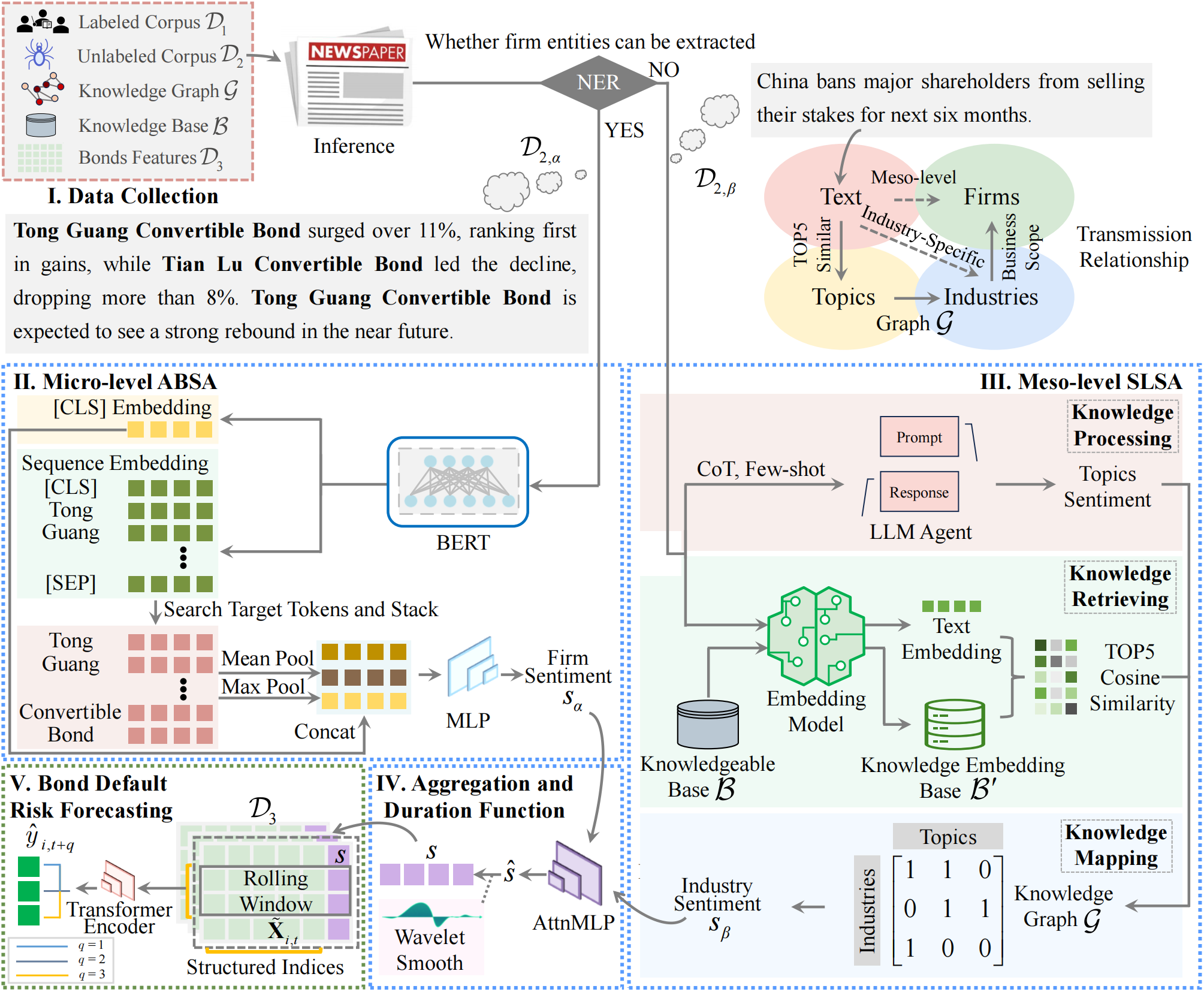
Overview of MulFSA Framework. Ⅰ (within the red box) is Task 1 Data Collection. Ⅱ, Ⅲ, Ⅳ (within the blue box) belong to Task 2 Multi-level Sentiment Analysis. Ⅴ (within the green box) is Task 3 Bond Default Risk Forecasting.

Data Statistics

MY ALT TEXT
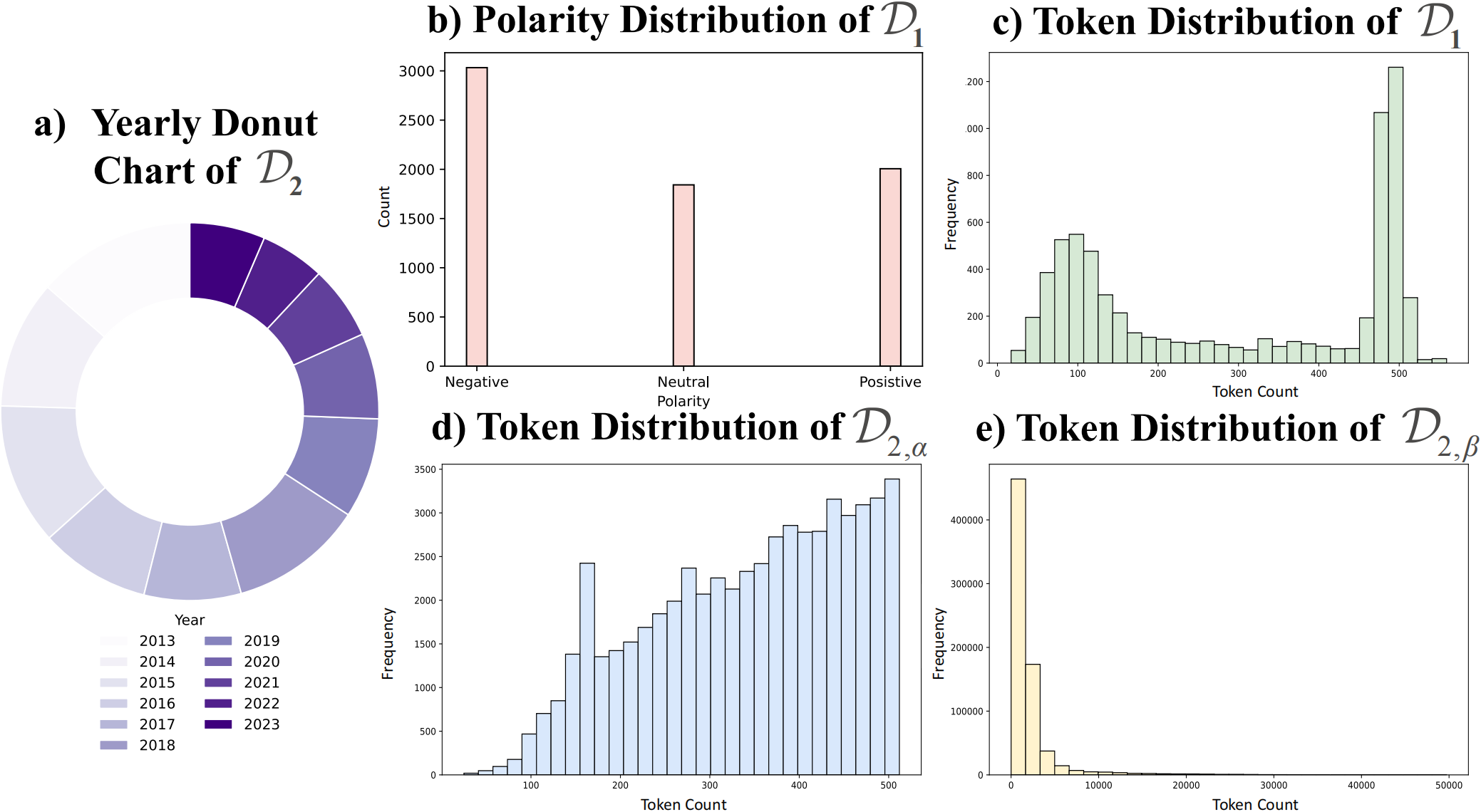
We constructed five datasets in total to support the implementation and evaluation of our MulFSA framework:
  1. A labeled sentiment corpus \( \mathcal{D}_{1} \) for ABSA fine-tuning.
  2. A Knowledge Graph \( \mathcal{G} \) of topics and a Knowledge Base \( \mathcal{B} \) containing topic definitions to support RAG.
  3. A large-scale unlabeled corpus \( \mathcal{D}_{2} \) for inference the sentiment times series of all bonds.
  4. A dataset \( \mathcal{D}_{3} \) of bonds with structured features for BDRF Modeling.

Experiments

MY ALT TEXT

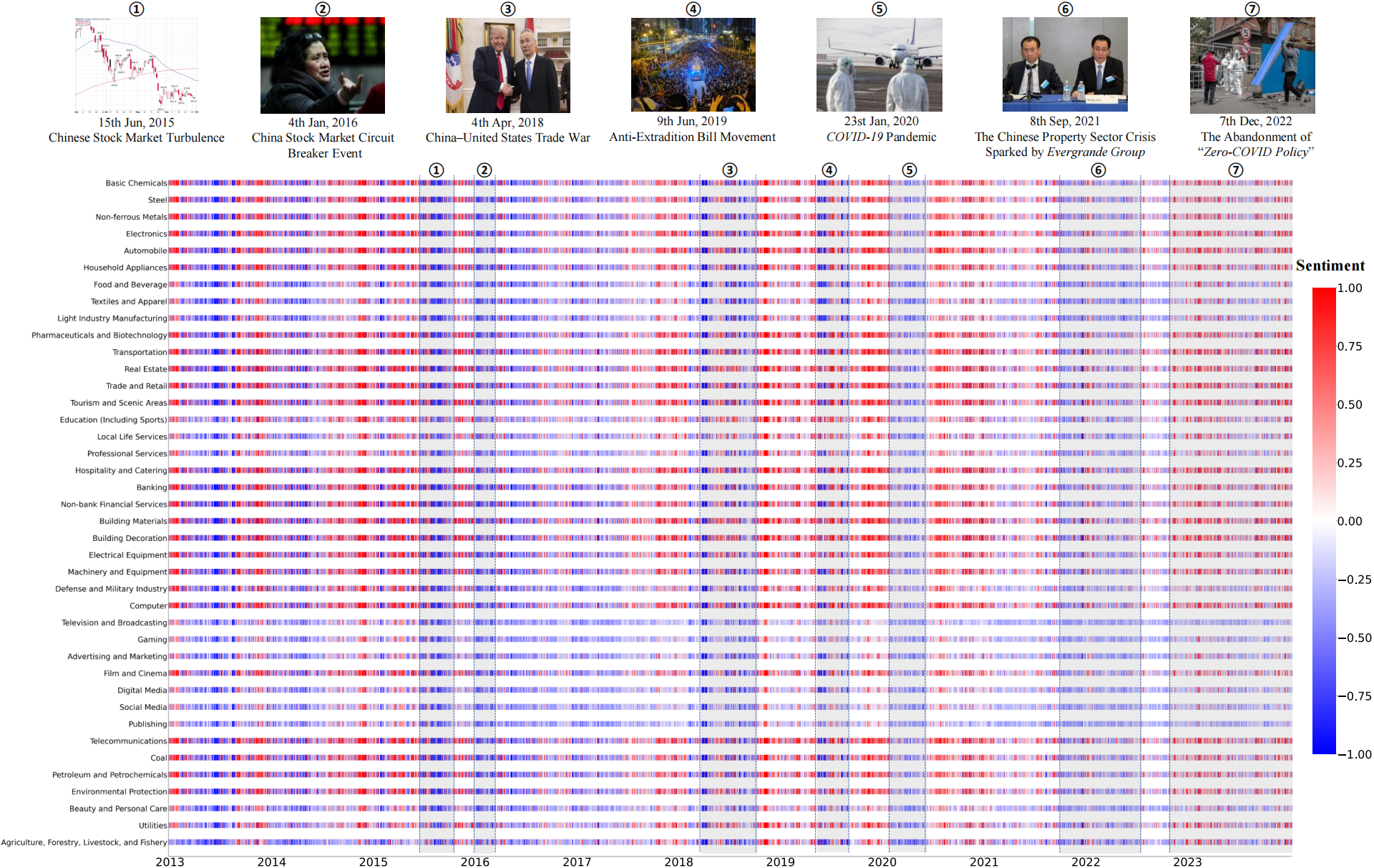
Sentiment Heatmap for 40 Industries. Values exceeding [-1,1] were truncated for display. The marked period exhibits a sentiment shift vis-à-vis its preceding period, aligning with the corresponding social event.


MY ALT TEXT

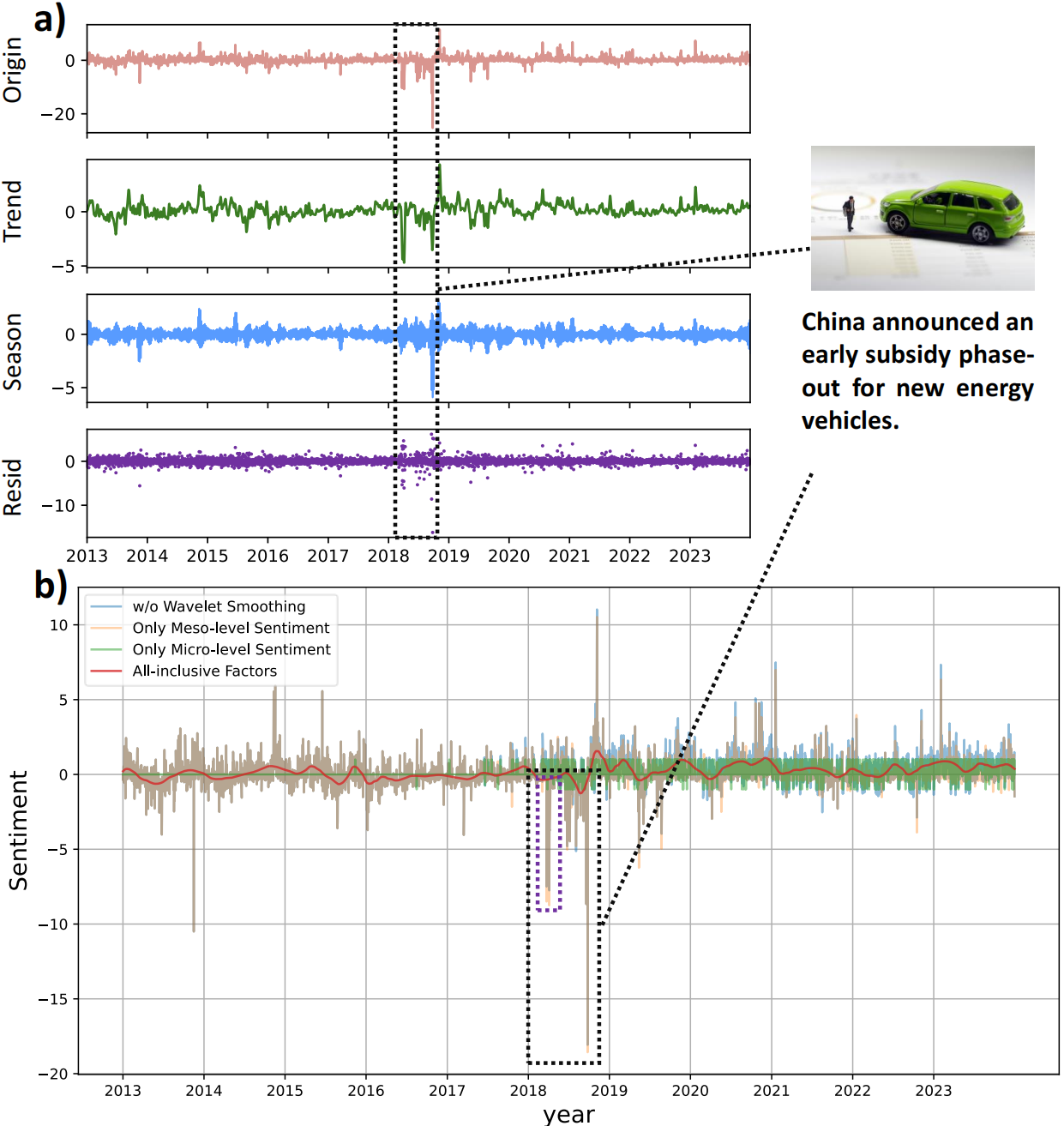
a) Industry Sentiment Time Series Decomposition of Automobile. From top to bottom, the four subplots represent the origin, trend, seasonality, and residuals. b) Component Visualization of CATL. Since industry sentiment is derived from topic sentiment, which is aggregated from daily sentiment, identical polarities across all related industries on certain days can produce extreme values in the visualization.

MY ALT TEXT

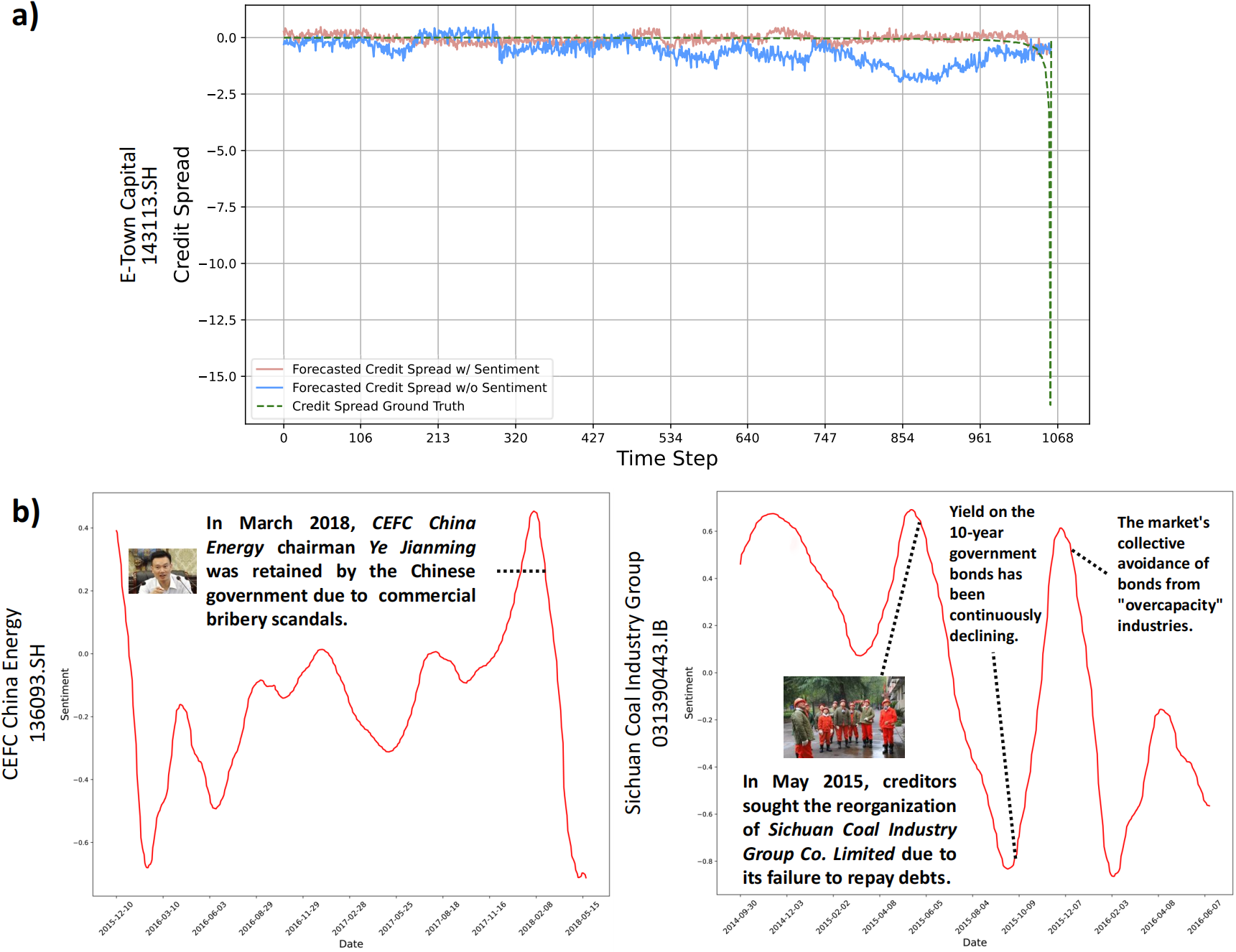
a) Visualization of The Difference in Forecasting. b) Visualization of Composite Sentiment Dynamics of Defaulted Bonds Preceding defaults. "SH" indicates the Shanghai Stock Exchange, and "IB" indicates the Investment Bank.


Comparison of BDRF results across Forecasting Targets \(q\).
Target
\(t+q\)
Sent. MAE
(e-5)
MAPE
(e-3)
\(p\) \(\Delta\)MAE
(%\(\downarrow\))
\(\Delta\)MAPE
(%\(\downarrow\))
\(t+1\) 11.24 9.46 n/a n/a n/a
\(t+1\) 11.37 8.37 0.081 -1.17 11.52
\(t+2\) 8.97 8.00 n/a n/a n/a
\(t+2\) 8.68 7.13 0.037 3.25 10.96
\(t+3\) 14.19 12.43 n/a n/a n/a
\(t+3\) 14.27 10.68 0.040 -0.57 14.07
\(t+4\) 16.69 10.44 n/a n/a n/a
\(t+4\) 16.57 8.10 0.048 0.72 22.47
Comparison of Baselines vs. our \(f^{*}\). Top rows: LLM-extracted sentiments.
Baseline Model MAE
(e-5)
MAPE
(e-3)
Baichuan-7B 8.98 8.03
DeepSeek-R1-Distill-Qwen-7B 8.87 8.18
XuanYuan-6B 8.79 7.64
Random Forest 50.29 25.08
XGBoost 19.50 14.29
LSTM 13.61 10.19
Our \(f^{*}\) 8.68 7.13
Ablation Study on MulFSA components.
Micro
Sent.
Meso
Sent.
Dur.
Func.
MAE
(e-5)
MAPE
(e-3)
\(p\) \(\Delta\)MAE
(%\(\downarrow\))
\(\Delta\)MAPE
(%\(\downarrow\))
8.97 8.00 n/a n/a n/a
8.79 10.06 0.057 2.00 -25.69
8.76 8.04 0.047 2.30 -0.42
15.57 43.48 ≈ 0.0 -73.58 -443.26
* * 8.95 8.02 0.101 0.22 -0.21
8.68 7.13 0.037 3.25 10.96
Comparison of different Duration Functions \(h(\cdot)\) in the BDRF model.
Duration Function MAE
(e-5)
MAPE
(e-3)
\(p\) \(\Delta\)MAE
(%\(\downarrow\))
\(\Delta\)MAPE
(%\(\downarrow\))
n/a 8.97 8.00 n/a n/a n/a
Smoothing Spline
(factor=16)
8.71 8.05 0.034 2.86 -0.63
Daubechies 4
(level=3)
8.82 9.38 0.045 1.69 -17.18
Daubechies 4
(level=6, \(f^{*}\))
8.68 7.13 0.037 3.25 10.96